


Simulation tool
Simulation tool provides a unique opportunity to understand polarisation beyond theoretical reading by offering a safe, experiential learning environment.
You can find a full instruction on how to use the tool here: https://doi.org/10.5281/zenodo.20347001 and a shorter ‘ready-to-use’ version below.
Simulating opinion dynamics
The simulation tool is designed to:
- Act as a virtual lab where users can explore how opinions change over time and how polarisation can develop through social interaction.
- Show how different settings affect opinion dynamics, allowing users to see how small changes can lead to different group outcomes.
- Support reflection by relating patterns of agreement, polarisation, and social division to real-life experiences in communities and society.
Introduction
🔈 If you’d like to listen to the Introduction text, click “play” (audio in English, created with the help of ttsfree.com text-to-speech tool):
There is a lot of theory on how people change their opinions when they discuss. These theories describe when people tend to agree or disagree with each other, and as a result, find agreement and move towards each other (assimilate) or disagree and separate, sometimes even breaking their connection (contrast).
Discussions between two people, or in a small group, can be studied in a laboratory. Here we can control, for example, what topic to discuss, what information to share and who can talk with whom. In this way, we can experimentally study when and how opinions change.
However, processes of polarisation usually happen in much larger groups, such as local communities and societies at large. With computer simulations, we can simulate opinion dynamics in large groups based on what we have learned from experiments with real people in small groups. In such Agent-Based Models (ABMs), people are represented as agents, and these agents can interact and, as a result, change their opinions, either assimilating or contrasting.
Simulating opinion dynamics
You can easily experiment with a simulation we have prepared for you. Click HERE (best viewed on a bigger screen) to open the simulation window. If you like to, you can dive right in. And if you’d like to know more about the tool and how to experiment with it, we invite you to read a short introduction below.
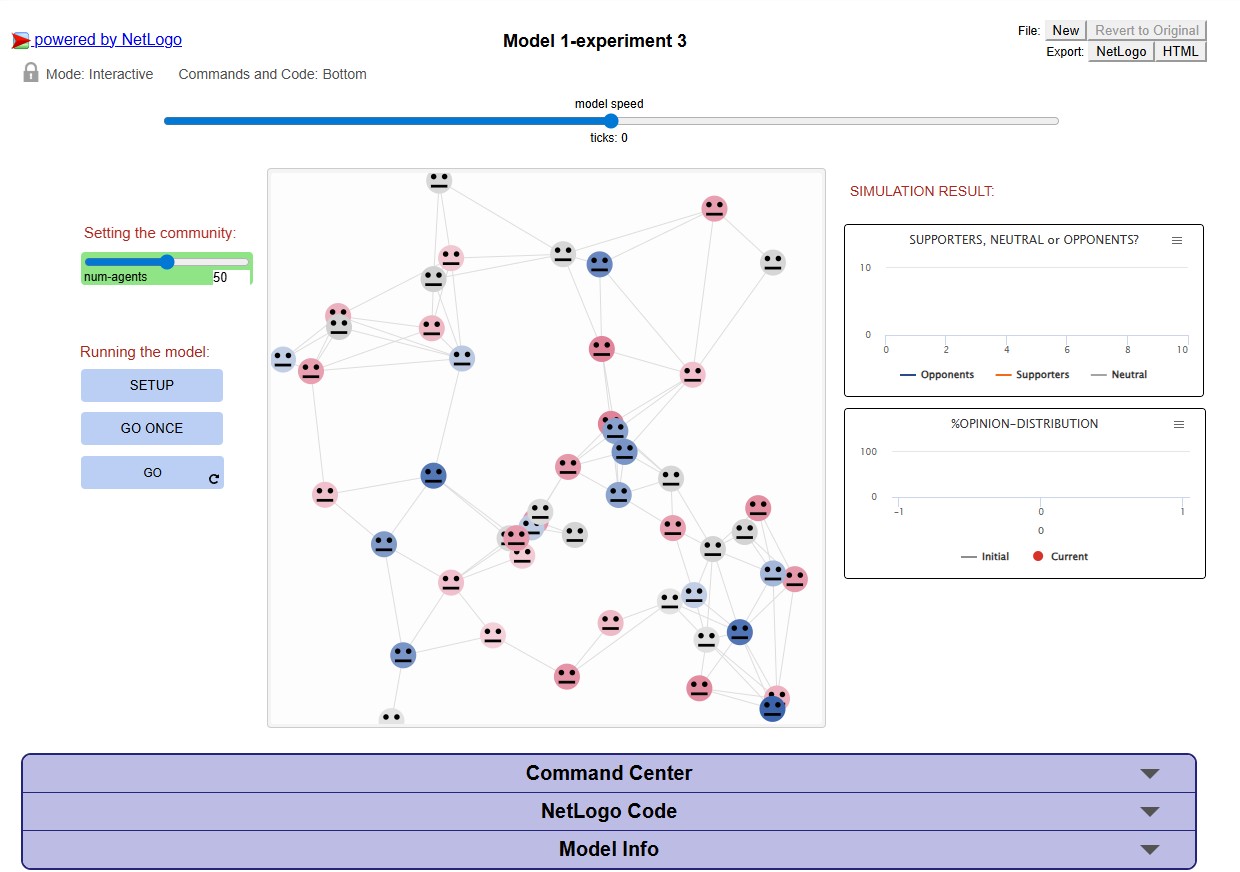
Click on SETUP, and you will see the following screen:
Experimenting with the tool
You see 100 agents appearing as dots with faces, having different colours expressing their opinion on a plan or issue. Blue agents oppose the plan, pink ones are supporters, and grey ones are neutral. The lines between agents indicate who is talking with whom, thus showing the social network connecting the agents.
Before we start our simulation, have a look at the two graphs on the right-hand side. The top one shows how many supporters, neutral and opponents there are. This gives you a nice overview of the developments of the opinions in our simulated community. The graph below shows the distribution of opinions, and it is easy to see if they come together (in the middle) or drive apart to the sides (polarisation).
When you click on GO, you see that the agents start moving, their colours change, and the lines connecting them may either become darker or fade away. When they assimilate, their colour becomes more similar, they move towards each other, and their connection gets stronger, visualised by a darkening line. On the contrary, when they contrast, their colour becomes more different, and they move away from each other, and the line connecting them is fading away. Clicking on SETUP again will start a new simulation. Run the simulation a couple of times.
As you will see, oftentimes polarisation and convergence emerge. However, we can also observe situations where there is a large group being neutral, and two opposing groups on the sides. In the graphs, you can nicely see the distributions of opinions that can grow out of this situation. Also, have a good look at the connections that grow strong or fade away.
- Can you think of situations in real life where opposing groups lose their connection?
- Can you think of an example of a group having a middle position and two opposing groups?
This model offers you an introduction to how opinion dynamics can be simulated. Many additional factors can be tested in such models. We can, for example, vary the tolerance of agents for different opinions. We can introduce opinion leaders (e.g., politicians) with moderate or extreme positions who can contact the whole population. In this way, simulations can teach us a lot about opinion dynamics taking place in large groups. Hopefully, we can also learn how to avoid situations where large groups polarise.
Learn more:
Agent-based modelling (YouTube video):
https://www.youtube.com/watch?v=FVmQbfsOkGc
More simulations on opinion dynamics and polarisation:
https://actiss.github.io/netlogomodels/
Our FutureLearn course on polarisation and dialogue:
https://www.futurelearn.com/courses/growing-apart
And if you’re interested in learning more about modelling social processes, try out these open online courses on social dynamics:
- People, Networks and Neighbours: Understanding Social Dynamics
- The Networks Connecting People – Social Network Analysis Course
- Decision Making in a Complex World
- Understanding Human Behaviour: Introduction to Game Theory and Shared Resources
If you’re interested in learning more about our simulation tool, please reach out to us at actiplex@uw.edu.pl or contact team members directly. You can find more information on our team section.